
Introduction
Sample evaporation is an often-overlooked source of analytical variability in HPLC, UHPLC, GC, and LC-MS workflows. When autosampler vials remain on the instrument for extended periods before analysis, solvent loss can gradually change sample concentrations and potentially impact quantitative results. The degree of evaporation depends on several factors, including:
- Solvent volatility
- Sample storage time
- Ambient conditions
- Vial closure design
- Septa composition
- Cap type
Understanding these factors can help laboratories select appropriate vial closure systems and maintain sample integrity throughout an analytical sequence.
Why Evaporation Matters
As solvent evaporates from an autosampler vial, the analyte concentration within the remaining solution increases. Potential consequences include:
- Quantitative inaccuracies
- Higher apparent analyte concentrations
- Reduced reproducibility
- Sample-to-sample variability
- Changes in calibration accuracy
- Method precision issues
These effects become increasingly important when samples remain in the autosampler for multiple hours or several days.
Factors That Influence Evaporation
Solvent Volatility
The volatility of the solvent is often the most significant contributor to evaporative loss. Highly volatile solvents generally evaporate faster than less volatile solvents, increasing the likelihood of concentration changes during storage and analysis. Common chromatography solvents may exhibit significantly different evaporation rates under identical conditions.
Cap and Septa Design
The vial closure system can strongly influence solvent retention. Variables include:
- Screw cap design
- Snap cap design
- Septa material
- Septa thickness
- Closure compression
- Seal integrity
A more effective seal generally reduces vapor loss and helps maintain sample stability.
Storage Duration
The duration that samples remain in the autosampler can significantly affect evaporation. Risk generally increases when:
- Long analytical sequences are used
- Overnight runs are performed
- Samples remain queued for several days
- Reanalysis of stored samples is required
For these applications, cap selection becomes especially important.
Comparing Screw Caps and Snap Caps
Both screw caps and snap caps are widely used in chromatography laboratories. Performance differences may be observed depending on:
- Storage duration
- Solvent type
- Environmental conditions
- Septa construction
Understanding the relative performance of these closure systems can help guide vial and cap selection for sensitive quantitative methods.
Evaporation Study Results
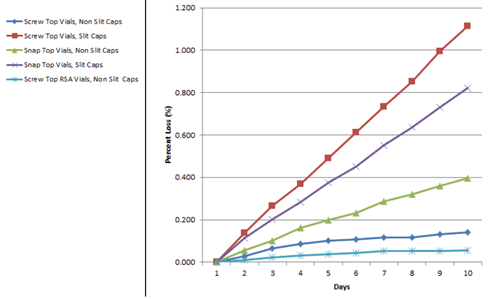
Comparison of evaporative loss under various storage conditions, solvents, and autosampler cap configurations. Results illustrate the impact of closure design and solvent volatility on sample preservation.
Interpreting Evaporation Data
Evaporation studies can help chromatographers evaluate:
- Which cap designs provide better sample protection
- Which solvents are most susceptible to evaporation
- Expected concentration changes during storage
- Suitability of a closure system for long-run analyses
The information can be particularly useful when developing methods requiring high quantitative accuracy.
Applications Where Evaporation Control Is Critical
Minimizing evaporation is especially important for:
- Trace-level analyses
- Stability studies
- Pharmaceutical assays
- Long LC-MS sequences
- Clinical analyses
- Automated overnight operation
- Method validation studies
These applications often require maximum sample consistency from the first injection to the last.
Best Practices to Minimize Evaporation
To reduce sample loss during storage and analysis:
- Use high-quality autosampler caps and septa.
- Select closure systems appropriate for the solvent being used.
- Minimize unnecessary storage times.
- Keep vial sealing surfaces clean.
- Verify cap integrity before analysis.
- Consider solvent volatility when planning long analytical sequences.
These precautions can help improve quantitative reliability and reduce variability.
Conclusion
Solvent evaporation from autosampler vials can have a significant impact on analytical accuracy, particularly during long analytical sequences or extended storage periods. While solvent volatility is a major factor, cap and septa selection also play critical roles in controlling evaporative loss. Understanding how different closure systems perform can help laboratories maintain sample integrity and improve the reliability of quantitative chromatographic results.